May 19, 1925 – February 21, 1965
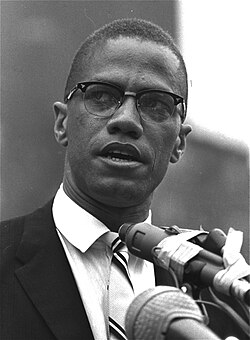
Malcolm X
"By Any Means Necessary"
Minister of Harlem's Temple No. 7 who transformed Black identity in America. He moved thousands from self-loathing to self-love, changed the language from 'Negro' to 'Black,' and challenged the nation to confront its racial contradictions.
Legacy of a Revolutionary
When Malcolm X arrived at 116th Street and Lenox Avenue in 1954, the Nation of Islam's presence in Harlem was minimal. Within three years, he transformed Temple No. 7 from a small storefront operation into the organization's most influential and prestigious temple outside Chicago headquarters.
He didn't wait for people to come to him. Malcolm took Islam to the streets—preaching on corners, in pool halls, and from rooftops. He directly confronted drug dealers, pimps, and gamblers, offering redemption through self-respect and discipline. His message was uncompromising: the Black man in America had been brainwashed to hate himself, and only through spiritual awakening and economic independence could he reclaim his dignity.
By 1960, Temple No. 7 was drawing hundreds to its Sunday services. Malcolm established Muslim restaurants, a school, and various businesses that employed dozens of Harlemites, proving his philosophy of Black economic self-sufficiency wasn't just theory—it was practice.
Published in 1965, just months after his assassination, "The Autobiography of Malcolm X" (written with Alex Haley) became an immediate classic. Unlike sanitized civil rights narratives, Malcolm's story was raw, unflinching, and revolutionary—from his father's lynching to his mother's institutionalization, from the streets of Boston and Harlem to prison conversion and eventual pilgrimage to Mecca.
The book transformed American literature. It introduced millions to the concept of Black pride before the Black Power movement officially began. It detailed the Nation of Islam's theology while critiquing its limitations. Most importantly, it showed Malcolm's evolution from separatist to humanist, from seeing all white people as devils to recognizing that people of all races could unite against oppression.
Today, it remains required reading in universities worldwide, having sold millions of copies and influenced generations of activists from the Black Panthers to Black Lives Matter.
After leaving the Nation of Islam in March 1964, Malcolm X undertook the Hajj pilgrimage to Mecca. The experience fundamentally transformed his worldview. Praying alongside Muslims of all races—white, brown, black—he realized that racism, not whiteness itself, was the enemy. He returned to America not as a separatist, but as an internationalist.
He founded the Organization of Afro-American Unity (OAAU), modeled after the Organization of African Unity, to link the struggle of Black Americans with independence movements across Africa, Asia, and Latin America. He spent his final year traveling to Ghana, Egypt, France, and England, building alliances and arguing that Black Americans needed to take their case to the United Nations as a human rights issue, not a domestic civil rights concern.
This shift terrified the FBI and CIA, who saw his international connections as a threat to American Cold War interests. But Malcolm persisted, arguing that "you can't understand what's happening in Mississippi if you don't understand what's happening in the Congo."
Join the Uptown Legacy Community
Get Harlem stories, events and exclusive guides.