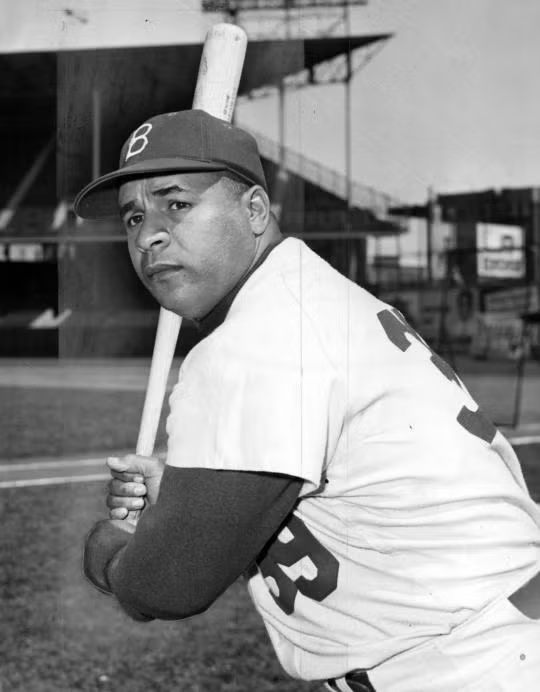
November 19, 1921 – June 26, 1993
Roy Campanella
"Campy" — The First Black Catcher in Major League Baseball
Roy Campanella broke barriers as the first African-American catcher in MLB history, bringing unmatched skill and infectious joy to the Brooklyn Dodgers. A three-time National League MVP and 1955 World Series champion, he overcame racial discrimination in the Negro Leagues to become one of baseball's greatest backstops. His career was tragically cut short by a car accident in 1958, but his legacy as a pioneer and humanitarian endures.
Legacy of a Pioneer
Following Jackie Robinson's footsteps, Campanella became the sixth African-American in modern Major League Baseball and the first Black catcher. He endured eight seasons in the Negro Leagues with the Baltimore Elite Giants before the Dodgers signed him in 1946.
His integration of the catcher position was groundbreaking—previously considered too "thinking-intensive" for Black players by segregationists. Campanella proved them wrong with eight consecutive All-Star selections (1949-1956) and elite defensive skills, throwing out 57% of base stealers, the highest percentage in MLB history.
Campanella dominated the National League with three MVP awards (1951, 1953, 1955)—a feat matched by only a handful of players in baseball history. His 1953 season remains legendary: 41 home runs, 142 RBIs, and a .312 batting average.
In 1955, he earned his third MVP while leading the Dodgers to their first World Series championship, hitting crucial home runs in Games 3 and 4 against the Yankees. Over ten seasons with Brooklyn, he compiled 242 home runs and 856 RBIs, cementing his status as arguably the greatest catcher of his era.
On January 28, 1958, a car accident on an icy road left Campanella paralyzed from the shoulders down, ending his playing career just as the Dodgers prepared to move to Los Angeles. Rather than retreat from public life, he became a Dodgers scout, coach, and director of community relations for 35 years.
Inducted into the Baseball Hall of Fame in 1969—the second African-American after Robinson—he spent decades inspiring others through his wheelchair-bound perseverance. He received the Presidential Medal of Freedom and remained a beloved figure in baseball until his death in 1993, proving that heroism extends far beyond the playing field.
Join the Uptown Legacy Community
Get Harlem stories, events and exclusive guides.