Uptown Legacy
The Food
of Harlem
Soul food. Barbecue. Caribbean. West African. Every plate tells the story of somewhere else that became home.
Harlem’s food is its autobiography. Every kitchen tells the story of a journey — from the Deep South, from the Caribbean islands, from West Africa. The recipes traveled in memory. The flavors adapted to what was available. And the restaurants that served them became more than businesses. They became landmarks, gathering places, and proof that a community was here, was fed, and wasn’t going anywhere.
1925 — 1986
Small’s Paradise
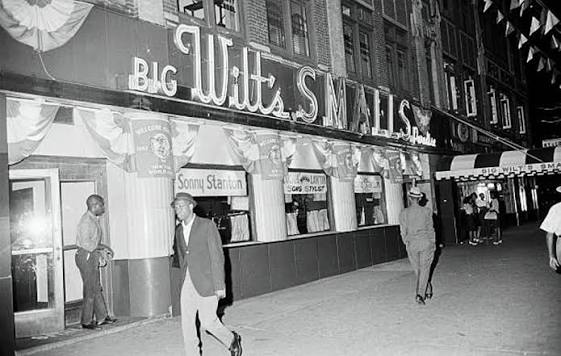
Edwin Alexander Smalls — descendant of Captain Robert Smalls, the former slave who commandeered a Confederate ship and sailed it to freedom, then became a United States Congressman from South Carolina — opened Small’s Paradise in the basement of 2294 Seventh Avenue at 135th Street on October 26, 1925. Nearly 1,500 people packed the room on opening night. It would become the longest-running nightclub in Harlem’s history.
Small’s was the only major Harlem nightclub owned by a Black man and open to everyone. The Cotton Club and Connie’s Inn only admitted white patrons unless you were a celebrity. Ed Smalls had no cover charge, served better food, and kept the doors open all night long — with a full breakfast dance and floor show starting at 6 a.m. while other clubs went dark.
The waiters at Small’s didn’t just bring your drink. They danced the Charleston while balancing trays of bootleg whiskey above their heads. They roller-skated between tables. They sang during the floor shows. Duke Ellington performed here. So did Sidney Bechet, Benny Carter, Roy Eldridge, and James P. Johnson. Langston Hughes and Countee Cullen were regulars. In 1943, a young man named Malcolm Little — before he became Malcolm X — worked as a waiter at Small’s when he first arrived in Harlem.
Ed Smalls sold the club in 1955 after 30 years. In the 1960s, basketball legend Wilt Chamberlain bought a controlling interest and renamed it Big Wilt’s Small’s Paradise. The club finally closed in 1986 — sixty-one years after that opening night. Today an IHOP sits in the street-level space. The building at 135th and Adam Clayton Powell still stands. But if those walls could talk, they’d sound like a jazz orchestra at dawn.
1938 — 1999
Wells
Chicken & Waffles
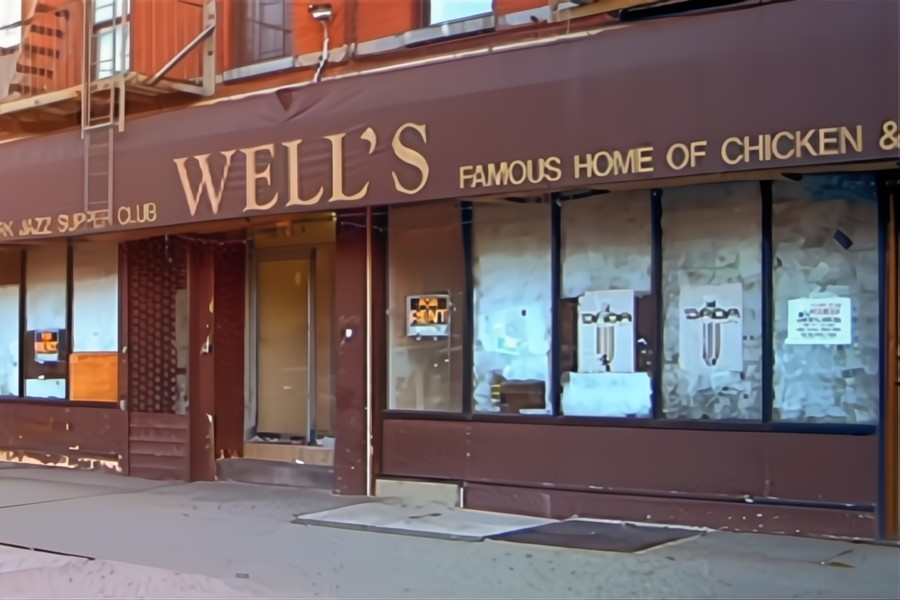
After the jazz clubs shut down, it was too late for dinner and too early for breakfast. So when Duke Ellington, Billie Holiday, and Nat King Cole walked into Wells Supper Club on Adam Clayton Powell Jr. Boulevard between 132nd and 133rd Streets, owner Joe Wells served them something in between — fried chicken with a side of waffles. An American classic was born right here in Harlem.
Nat King Cole held his wedding reception at Wells. The late-night crowd made it the place to be after every show, every set, every gig. The Amsterdam News called it a place where “no appetites are safe from the magnificent Southern Creole cuisine.”
In 1986, Wells trademarked the slogan “Home of Chicken and Waffles Since 1938.” The restaurant finally closed in 1999, but the dish it invented lives on in every chicken-and-waffle spot in America. They all trace back to this one kitchen on Seventh Avenue.
1948 — 2012
Sherman’s
Bar-B-Q
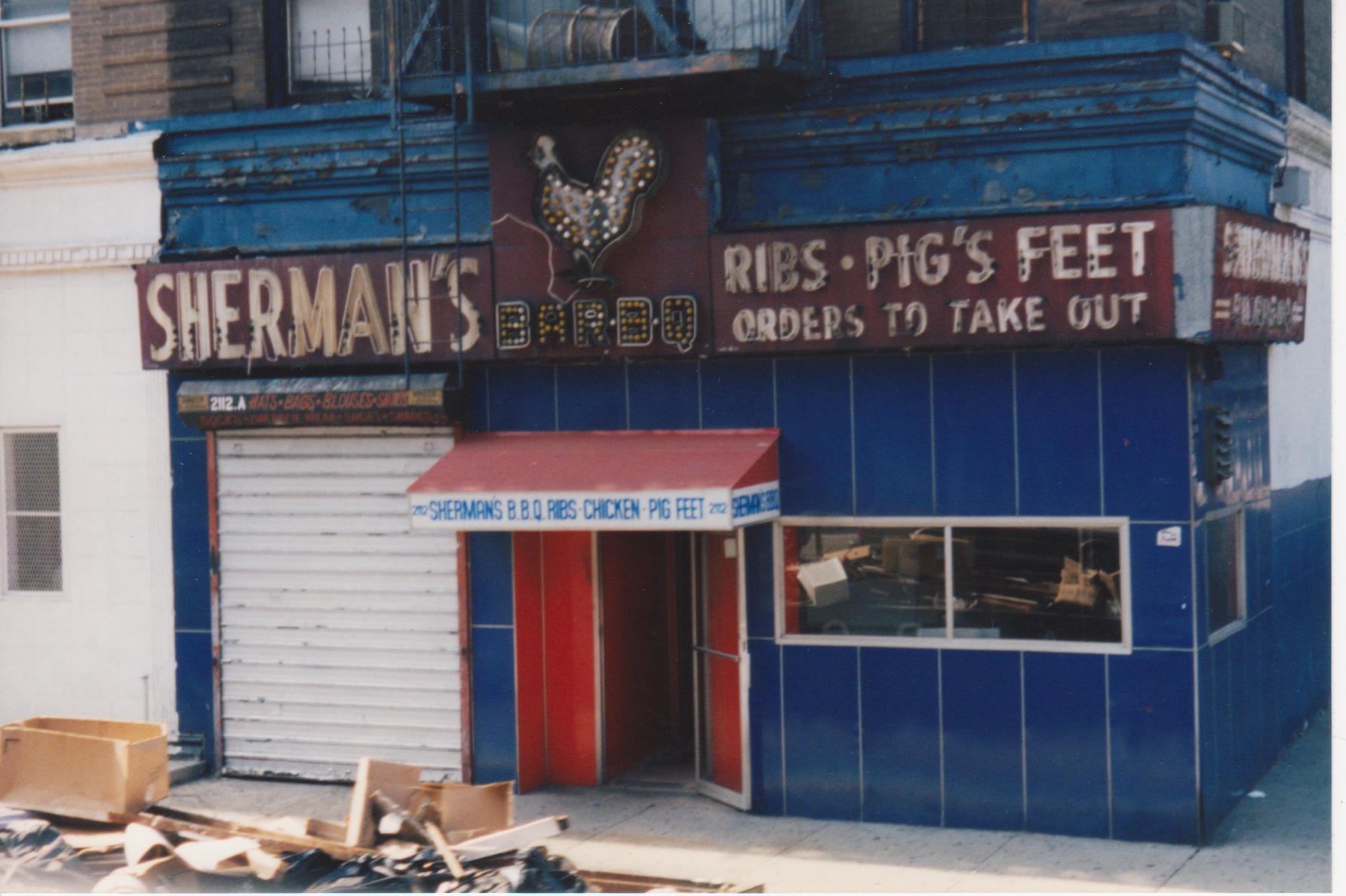
Sherman Hibbitt opened his first barbecue joint in 1948. Over the years he built a chain across Harlem — on Amsterdam Avenue in the 150s, on 8th Avenue in the 140s, and the flagship on Adam Clayton Powell Jr. Boulevard between 145th and 146th Streets. The Art Deco storefront, the neon rooster sign, and the words “RIBS · PIG’S FEET · ORDERS TO TAKE OUT” were Harlem landmarks.
The menu was six or seven items. Ribs, chicken, pig feet, barbecue spaghetti, potato salad, collard greens, and cornbread. No tables, no chairs, no decor — just a revolving window in the glass where they put out plates and took in cash. Families drove in from New Jersey for the ribs. Kids in the neighborhood could get lunch for fifty cents.
In the early 1960s, three local girls gaining fame as the Ronettes brought their British boyfriends to the Amsterdam Avenue location for some real American food. Those boyfriends were the Beatles. For years after, the owner would call out any one of the sisters by saying, “You’re the little girl who brought the Beatles here!” Sherman’s last location closed around 2012. Nobody has replicated the flavor of that tangy sauce since.
Since 1981
Chicken Delight
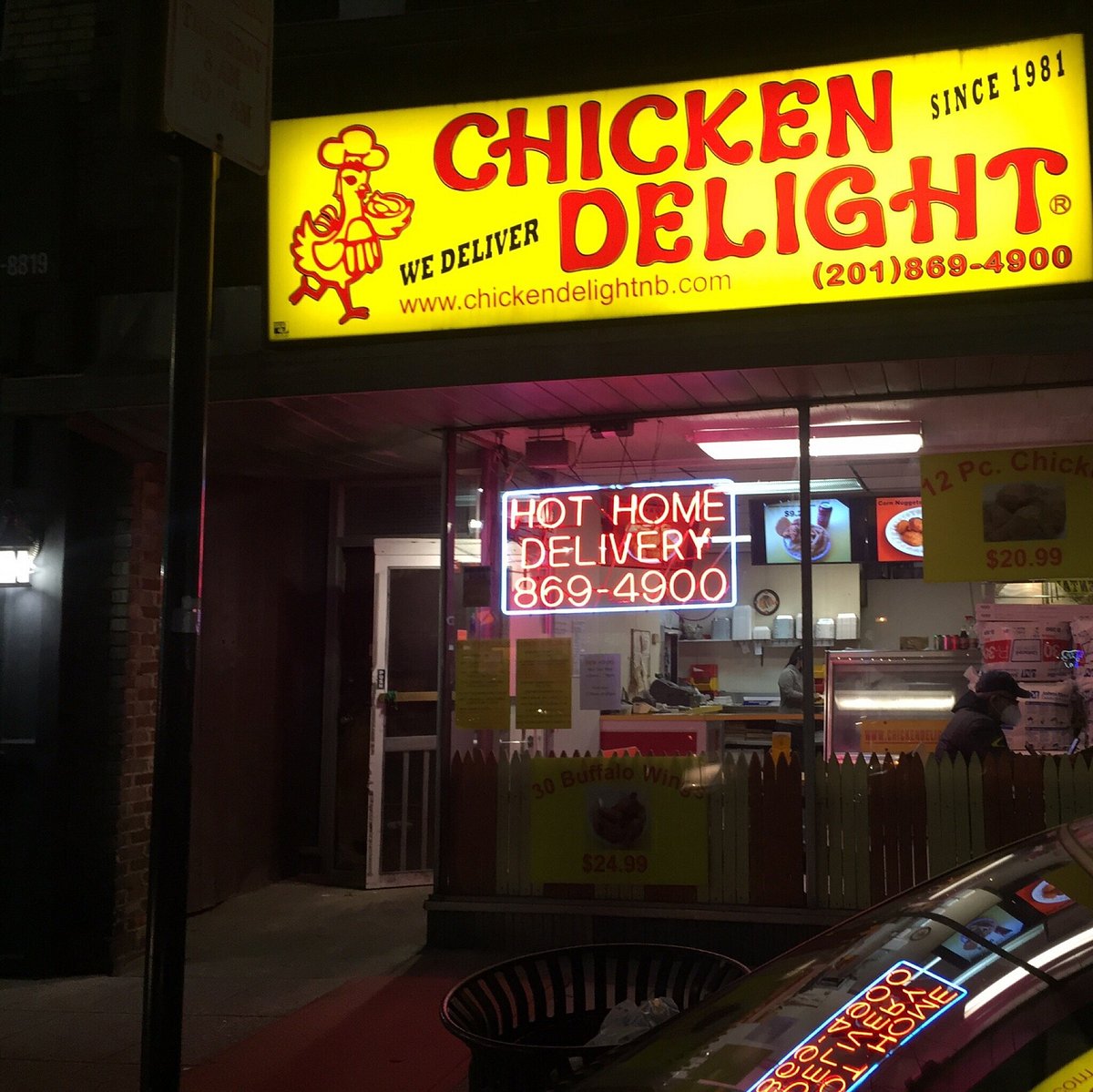
“Don’t Cook Tonight — Call Chicken Delight.” That slogan became a household phrase. The original chain started in Illinois in 1952, pioneering fast food delivery straight to your door. At its peak, over 1,000 locations across America.
In Harlem, Chicken Delight was one of the first spots where you could call a number and have hot fried chicken delivered to your apartment. Before apps, before Uber Eats, before any of it — there was Chicken Delight with a phone number on the window and a driver who knew every building on the block.
The yellow sign with the cartoon rooster, the “HOT HOME DELIVERY” neon in the window, the 12-piece chicken box for $20.99 — that’s what home tasted like on a night when nobody felt like cooking. Chicken Delight didn’t need to be fancy. It needed to be there, and it was.
“I see food as a major uniting and defining factor in Harlem’s dynamic culture.”
— Marcus Samuelsson
Since 1962
Sylvia’s
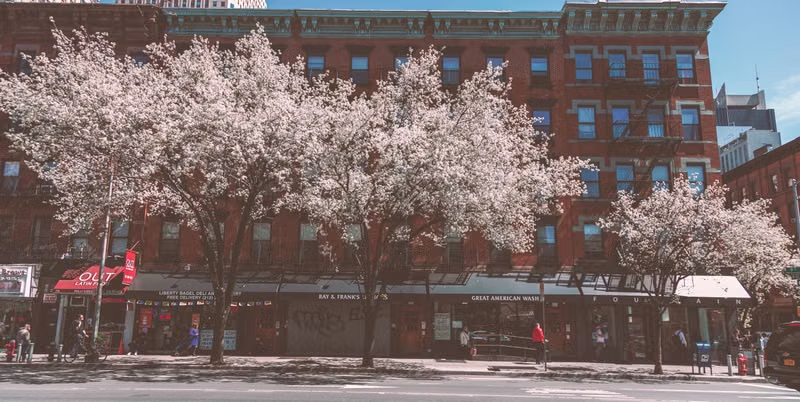
Sylvia Woods opened her restaurant at 328 Malcolm X Boulevard in the summer of 1962. Six booths and fifteen stools. She served her first fried pork chop that year and never stopped. Within a decade she was the Queen of Soul Food, and her restaurant occupied an entire block.
Presidents have eaten here. So have three generations of Harlem families. The fried chicken, collard greens, candied yams, ribs, cornbread, and peach cobbler are the standard. Sylvia passed away in 2012. Her family still runs it. Sunday gospel brunch still fills every seat.
Island Flavors
The Caribbean
Kitchen
West Indian immigrants brought jerk chicken, oxtail stew, curry goat, roti, fried plantains, and rum punch. Caribbean restaurants and takeout windows have been part of Harlem since the 1920s, when Jamaican, Trinidadian, and Barbadian families first settled uptown.
Scotch bonnet heat, allspice, thyme, coconut milk, tamarind. Walk the side streets and you’ll find spots serving the same recipes for decades, run by families who brought the flavors across the water. Caribbean food in Harlem isn’t fusion. It’s home cooking, transplanted and thriving.

Little Senegal
West African
Flavors
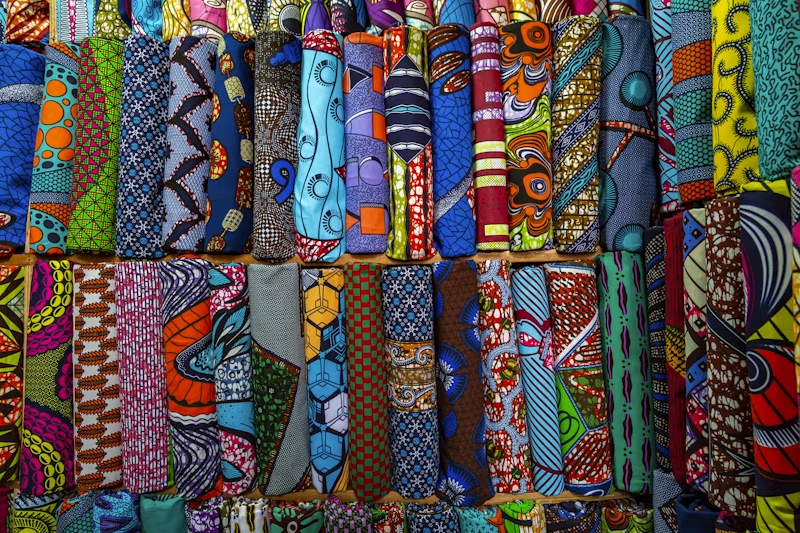
On 116th Street between Lenox and Frederick Douglass, the scent changes. Groundnut stew. Thieboudienne. Mafé. Yassa. This is Little Senegal, where West African restaurants serve the food of Dakar, Bamako, and Conakry.
These aren’t restaurants chasing trends. They’re feeding a community, the same way Sylvia’s feeds its community and the way Sherman’s fed its community for sixty years. Different kitchens, same purpose.
Eating in Harlem Today
Red Rooster on Lenox Avenue mixes soul food with Ethiopian, Scandinavian, and French influences. Amy Ruth’s names dishes after Black legends. Charles Pan-Fried Chicken keeps it simple with cast-iron perfection. Melba’s brings Southern classics with a modern touch.
The old places set the standard. Some survived, some didn’t. But the tradition they built — food as community, food as culture, food as identity — lives on every block. Harlem still eats well. And every plate still tells a story.