Uptown Legacy
The Music
of Harlem
From the drum to the turntable. Every beat that shaped America started on these blocks.
Harlem didn’t just play music. It invented it, reinvented it, and sent it out to the world. Jazz was born in New Orleans but it grew up in Harlem. Gospel came from the South but it shook the walls of Harlem’s churches. The African drum found its American home on 116th Street. And hip-hop — the most dominant cultural force of the last fifty years — has roots that trace straight back to these blocks. This is where the beat lives.
Since 1960
LaRocque Bey
& the African Drum
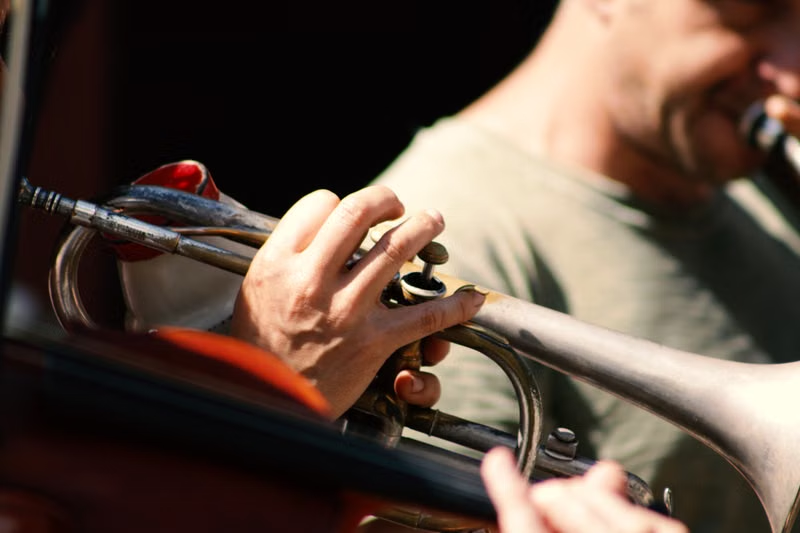
In 1960, a drummer and dancer named LaRocque Bey opened the oldest African dance school in the United States — right here in Harlem, in the Lincoln Projects. Classes cost twenty-five cents. What he taught was priceless.
Bey was a percussionist who performed alongside Babatunde Olatunji, the Nigerian master drummer who brought traditional African rhythms to American audiences. Together they built a bridge between the continent and the community. In 1959, Bey composed “Funga Alafia” — a welcome song that blended Yoruba words with an African American folk melody. That song is now sung by children and communities around the world. Most people don’t know it was written in Harlem.
The LaRocque Bey School of Dance Theatre, now based at the Malcolm Shabazz Cultural Center on 116th Street and Malcolm X Boulevard, has operated for over sixty years. It has touched the lives of people who went on to share stages with Duke Ellington, Otis Redding, Debbie Allen, George Clinton, Phylicia Rashad, and Savion Glover.
And there’s a direct line from Bey’s African dance to something nobody expected. In the mid-1970s, young dancers in the Bronx and Harlem — some of them students of Bey’s troupe and Olatunji’s dancers — brought those movements to Afrika Bambaataa’s block parties. The Zulu Kings, one of the first breakdancing crews, were formed at a talent show where African dance troupes performed. The drum that LaRocque Bey carried from Africa to Harlem helped birth hip-hop culture.

1923 — 1940
The Cotton Club
& the Jazz Age
In 1923, gangster Owney Madden took over a club at 142nd Street and Lenox Avenue and turned it into the Cotton Club — a speakeasy that sold bootleg beer to a whites-only audience while Black musicians played the most extraordinary music in the world. The name alone tells you the ugly truth of the era. But the music was unrestrained.
Duke Ellington led the house band from 1927 to 1930. Cab Calloway took over after him. Ethel Waters, Lena Horne, Louis Armstrong, and Bessie Smith all performed here. The Cotton Club broadcast live radio shows that carried Harlem’s sound to living rooms across America. Jazz went from a neighborhood sound to a national phenomenon — and it happened from this stage.
The Cotton Club closed in 1940. Today it’s an apartment building. But the music that came out of it changed everything.
1926 — 1958
The Savoy
Ballroom
If the Cotton Club was where you watched, the Savoy Ballroom was where you danced. Stretching the entire block between 140th and 141st Streets on Lenox Avenue, the Savoy opened on March 12, 1926, with a block-long dance floor, mirrored walls, marble steps, and double bandstands for the famous battle of the bands.
Unlike the Cotton Club, the Savoy was open to everyone. “We didn’t have segregation at the Savoy,” said legendary Lindy Hopper Norma Miller. “The Savoy opened the doors for all people being together.” It was one of the first racially integrated public venues in the country.
Chick Webb led the house band. Duke Ellington and Cab Calloway competed in battle-of-the-bands showdowns that shook the walls. And on that dance floor, the Lindy Hop was born — the swing dance that swept the world. The Savoy earned its nickname: “The Home of Happy Feet.” It closed in 1958. Today it’s a housing project. But the dances born inside it never stopped.
Since 1934
The Apollo
Theater
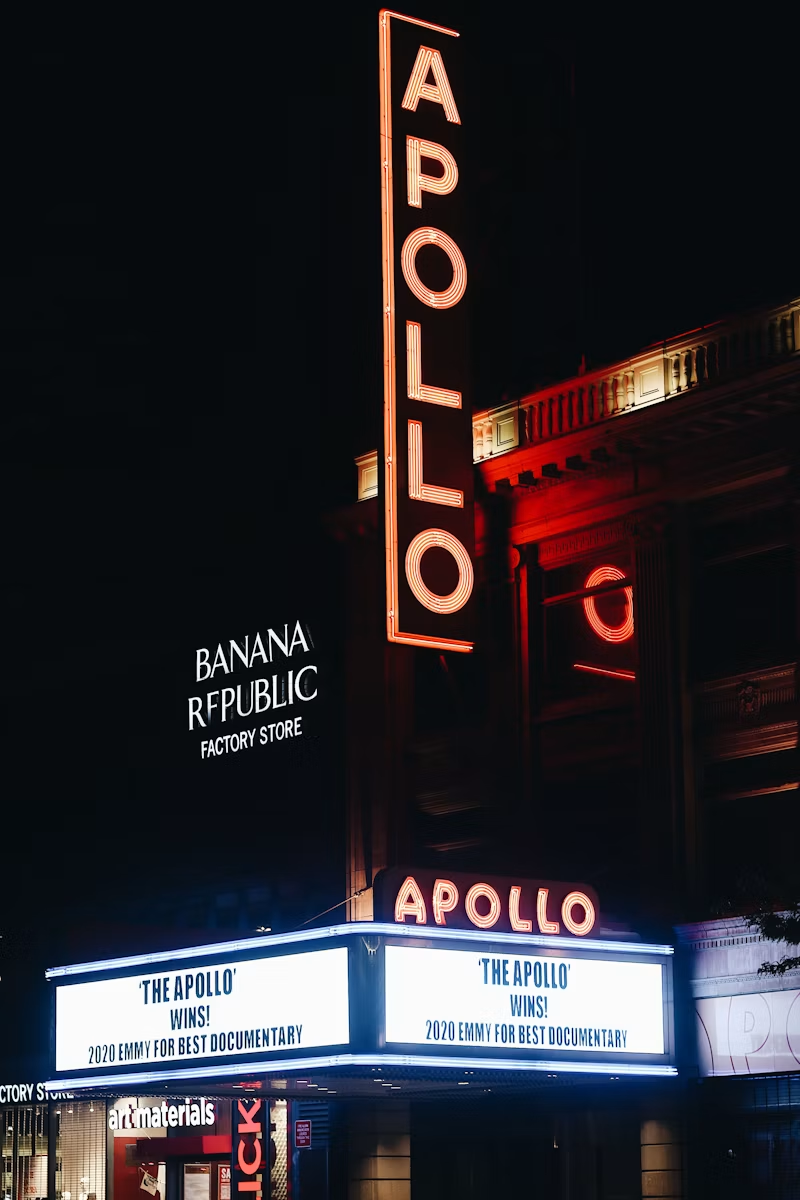
On January 26, 1934, the Apollo Theater opened at 253 West 125th Street with a show called “Jazz a la Carte” headlined by Benny Carter and his Orchestra. The New York Amsterdam News called it “one of the most important theater events in the history of Harlem.” They weren’t exaggerating.
A seventeen-year-old Ella Fitzgerald won Amateur Night in 1934. She’d planned to dance, but when she saw the competition, she sang instead. James Brown recorded “Live at the Apollo” in 1962 — one of the greatest live albums ever made. Billie Holiday, Aretha Franklin, Stevie Wonder, Marvin Gaye, Michael Jackson, Lauryn Hill — they all stood on this stage.
Amateur Night still runs. The Apollo is still the place where you earn Harlem’s respect or you hear about it from the crowd. Nearly a century later, it remains the most important stage in Black music.
Since 1938
Minton’s Playhouse
& the Birth of Bebop
At 210 West 118th Street, in the dining room of the Cecil Hotel, Teddy Hill opened Minton’s Playhouse in 1938. Monday nights became legendary — open jam sessions where musicians tested new ideas, pushed boundaries, and broke every rule the swing era had established.
Thelonious Monk was the house pianist. Dizzy Gillespie, Charlie Parker, Kenny Clarke, and Charlie Christian showed up to play. What came out of those Monday nights was bebop — faster, more complex, more daring than anything jazz had attempted before. The music was so revolutionary that some older musicians couldn’t keep up. That was the point.
Bebop didn’t just change jazz. It changed what music could be. It proved that popular music could also be intellectual, that rhythm could be architecture, that a solo could tell a story. And it happened in a dining room on 118th Street.
“It don’t mean a thing if it ain’t got that swing.”
— Duke Ellington
The Spirit
Gospel &
the Church
Before the clubs opened, before the bands set up, the music was in the churches. Southern migrants brought gospel to Harlem — the raw, full-throated, hand-clapping, foot-stomping praise music that had sustained them through everything the South threw at them.
The Abyssinian Baptist Church, founded in 1808 and moved to Harlem in 1923, became one of the most powerful congregations in America. Its choir set the standard. Storefront churches on every block — over a hundred of them by the mid-1920s — filled the streets with music every Sunday morning.
Gospel didn’t stay in the church. It crossed over into soul, into R&B, into the voices of Aretha Franklin and Sam Cooke and Whitney Houston. Every note they sang carried the church with it. And if you walk into a Harlem church on a Sunday morning today, you’ll hear exactly where it all started.
1970s — Present
Hip-Hop &
the Next Beat
In 1973, DJ Kool Herc threw a back-to-school party in the Bronx and isolated the break in a funk record, looping it so dancers could go off. Hip-hop was born. But the culture it grew from — the drumming, the dance, the spoken word, the street-corner storytelling — was already alive in Harlem.
Afrika Bambaataa’s Zulu Nation drew directly from the African dance traditions that LaRocque Bey and Babatunde Olatunji had been teaching uptown since the 1960s. The breakdancing crews that formed in the mid-70s moved with rhythms that connected back to the drum circles in Harlem’s parks. The MCs who rhymed over beats were descendants of the street-corner poets and the spoken-word tradition that Langston Hughes had championed decades earlier.
From Big L to Cam’ron, from the Diplomats to A$AP Rocky, Harlem has produced hip-hop artists who carry the neighborhood’s swagger and storytelling into every bar. The music changed form. The spirit didn’t.
Harlem’s Music Today
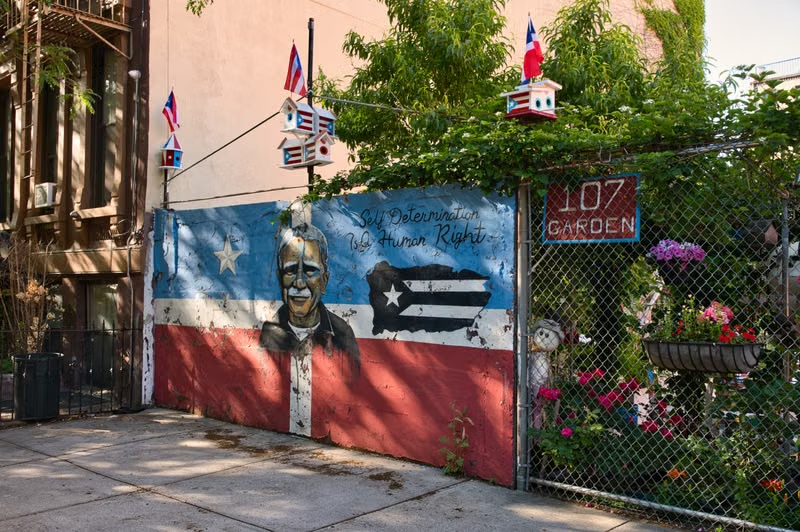
The Apollo still holds Amateur Night. Minton’s reopened as a supper club on 118th Street, serving cocktails where bebop was born. Bill’s Place on 133rd Street keeps the live jazz tradition alive in a space small enough to feel the bass in your chest. The LaRocque Bey School of Dance Theatre still teaches African dance at the Malcolm Shabazz Cultural Center, sixty-three years and counting.
Harlem has given the world jazz, swing, bebop, gospel, soul, funk, and hip-hop. Each one grew out of the one before it. Each one started with the same thing — people who had something to say, and the rhythm to say it with. The beat hasn’t stopped. It’s just changing form.